

Short answer: hire freelancers when the work is occasional, small and well-defined and you can direct it; build an in-house team when you ship creative every week and want it fully under your control; use a studio or agency when the work spans several disciplines that must stay consistent, or you need senior craft without carrying the salaries. Most growing businesses use a mix — the trick is matching each job to the right one.
The three options at a glance
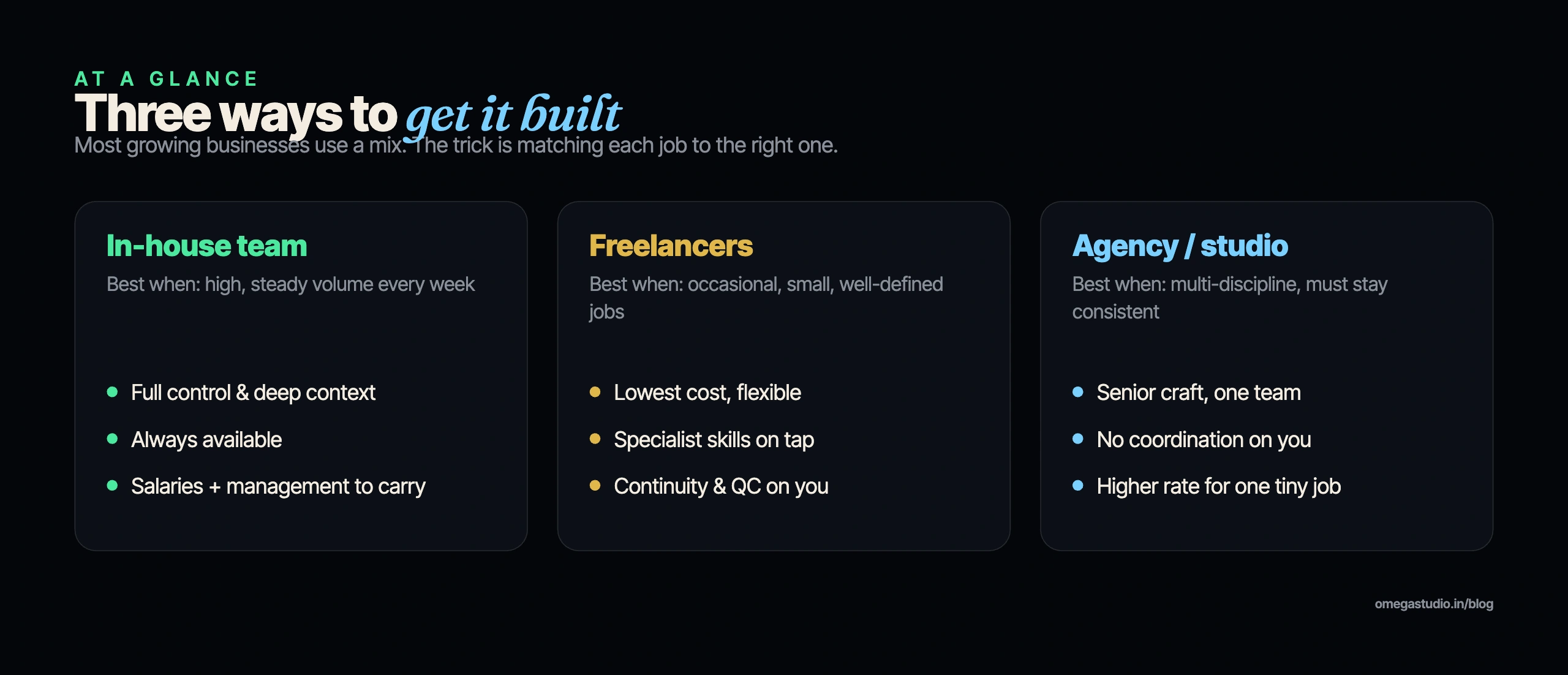
| Best when | Strengths | Watch out for | |
|---|---|---|---|
| In-house team | High, steady volume of creative every week | Full control, deep context, always available | Salaries, management, and gaps in specialist skills |
| Freelancers | Occasional, small, well-defined jobs | Lowest cost, flexible, specialist skills on tap | Availability, continuity and quality control are on you |
| Agency / studio | Multi-discipline work that must stay consistent | Senior craft, one team, no coordination on you | Higher day rate than a freelancer for a single small job |
In-house: control, at a fixed cost
An in-house team makes sense once your creative volume is high and constant — a brand shipping social, campaigns and content every week. You get people who live inside the business, understand it deeply, and are always on hand.
The trade-off is fixed cost and management. Salaries run whether the workload is full or not, someone has to lead the team, and a small in-house team rarely covers every discipline — you’ll still reach for a specialist when a film or a rebrand comes up.
Freelancers: cheapest for the right job
For a one-off logo, a batch of edits or a single landing page, a good freelancer is often the most efficient choice — low cost, specialist skill, no long commitment. It works best when the scope is clear and you can art-direct the work yourself.
The risks are the ones you now own: availability when they’re busy, consistency across several freelancers, and quality control. Coordinating five freelancers into one coherent brand is a real job — usually yours.
Agency or studio: craft without the payroll
A studio earns its place when the work spans disciplines that have to look like one company — brand plus website plus film — or when you need senior craft you don’t want to hire full-time. You get a team that shares one brief, so the output arrives consistent, and you don’t carry the salaries or the coordination.
For a single tiny job, a studio’s day rate is higher than a freelancer’s. The value shows up on multi-discipline work and anything where getting it right matters more than getting it cheapest. We unpack this in what a full-service creative studio actually does.
A simple way to decide
- How often do you need it? Rarely → freelancer. Every week → in-house or a retainer. In bursts around projects → a studio.
- How many disciplines? One → a specialist freelancer or agency. Several that must match → a studio.
- Who manages it? If nobody on your side has time to coordinate, a studio absorbs that. If you enjoy directing the work, freelancers can be cheaper.
- How much does getting it right matter? For a flagship brand, film or site, senior craft pays back. For internal or throwaway work, cheaper is fine.
The hidden cost of the cheapest option
The lowest quote is rarely the lowest cost. Five freelancers at good rates can still cost you more once you add the hours you spend briefing each one, reconciling their work, fixing inconsistencies and project-managing the whole thing. That coordination is real work — a studio absorbs it, and an in-house lead is paid to do it. Count it before you compare quotes.
What each option actually costs
Rates depend on the discipline, but our 2026 cost guides give you honest ranges to plan against: branding, websites and video production. Use them to sanity-check any quote, whoever it’s from.
How Omega Studio fits
Omega Studio India works as the studio option — a Bangalore team across ten disciplines, on project or retainer — and is happy to tell you when a freelancer or an in-house hire would serve you better for a given job. If you’re weighing your options, how to choose a creative agency in Bangalore is the companion read.
Frequently asked questions
Is it cheaper to hire freelancers or an agency?
For a single, well-defined job, a freelancer is usually cheaper. For multi-discipline work, an agency or studio is often cheaper overall once you count the coordination and consistency you’d otherwise manage yourself.
When should I build an in-house creative team?
When your creative volume is high and constant — weekly social, campaigns and content. Below that, a retainer or freelancers are usually more efficient than full-time salaries.
Can I mix freelancers, in-house and an agency?
Yes, and most growing businesses do. Keep steady, high-volume work in-house or on a retainer, use freelancers for occasional specialist tasks, and bring in a studio for multi-discipline projects.
What’s the biggest hidden cost of using freelancers?
Coordination. Briefing, reconciling and quality-controlling several freelancers into one consistent brand is real work that usually falls on you.
Who should build my brand identity?
For a serious identity that has to work across channels, a studio or a strong branding specialist — not a low-cost logo freelancer. See our branding cost guide for the tiers.
Does an agency work with my in-house team?
A good one does — taking the specialist or multi-discipline work while your team handles day-to-day. Agree who owns what up front.
Not sure which setup fits your next project? Send us your brief and you’ll get a reply within 48 hours and an honest recommendation — even when that’s not us.