

Short answer: a brand guidelines document (or brand book) is the rulebook that keeps your brand consistent when different people use it. At minimum it covers logo usage, colour, typography, imagery and voice; a fuller one adds strategy, layout, iconography, do’s and don’ts and real applications. Its job is simple: so a designer, printer or agency you’ve never met can make something that looks unmistakably like you.
Why guidelines matter
Consistency is what turns a logo into a brand. The moment more than one person touches your brand — a freelancer, a printer, a new marketing hire, an agency — inconsistency creeps in: the logo squashed, an off colour, the wrong font. Guidelines are the single source of truth that stops that, so your brand looks the same on a website, a business card, a shopfront and an Instagram post. Without them, you pay to rebuild consistency every time someone new gets involved.
What goes into a brand guidelines document
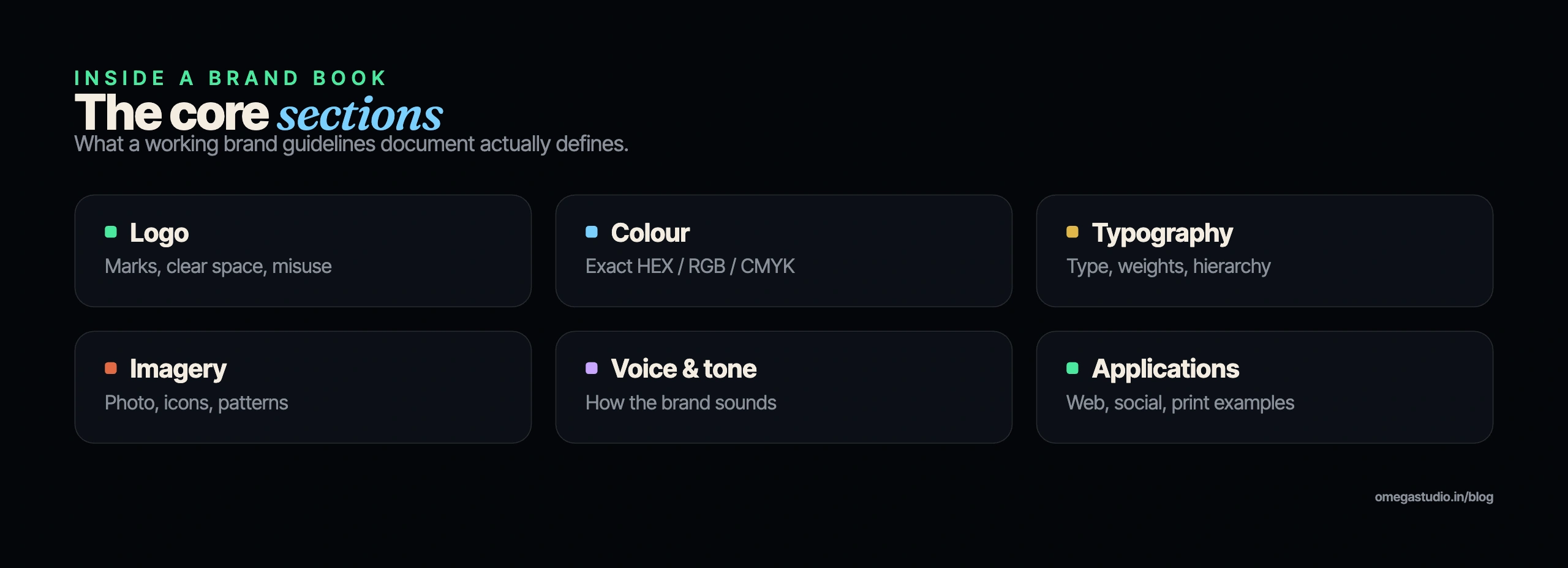
| Section | What it defines |
|---|---|
| Brand basics | Positioning, personality and promise in a line or two — the why behind the look |
| Logo | Primary and secondary marks, variations, clear space, minimum size, and misuse examples |
| Colour | Primary and secondary palette with exact values (HEX, RGB, CMYK, Pantone) and usage rules |
| Typography | Typefaces, weights, and how to set headings, body and detail text |
| Imagery | Photography style, iconography, illustration, patterns and graphic devices |
| Voice & tone | How the brand sounds in words — and what it never says |
| Layout | Grids, spacing and how elements combine on a page |
| Applications | Real examples — website, social, print, signage — so the rules feel concrete |
The two rules most guidelines get wrong
- Show the wrong, not just the right. The most useful pages are the “don’ts” — the squashed logo, the off colour, the busy background. People learn the rules faster from what to avoid.
- Give exact values, not vibes. “A warm blue” is useless to a printer. HEX, RGB, CMYK and Pantone codes are what keep colour consistent across screen and print.
How big should a brand book be?
It should be as big as it needs to be, and no bigger — a document nobody reads protects nothing. A useful scale:
- Mini guide (a few pages): logo, colour, type and basic do’s and don’ts. Bundled with most studio logo packages, and enough for a small business.
- Full brand book (20–60+ pages): everything above plus strategy, voice, imagery, layout and applications. Part of a full identity system, and what larger or scaling brands need so any vendor stays on-brand.
Which tier you need tracks the branding you’re buying overall — see how much branding costs in India and the difference between a logo, identity and strategy.
Who actually uses it
Guidelines aren’t a vanity document — they’re a working tool for the people who touch your brand after the studio hands it over: your in-house team, freelancers, printers, agencies, and future you. That’s the test of a good brand book: hand it to someone new, and they can make something on-brand without asking you. If they can’t, the document has failed.
What Omega Studio delivers
Omega Studio builds guidelines sized to the project — a clear mini guide with a focused identity, or a full brand book with a strategy-led programme — and hands over the source files so the brand is yours to run. See our branding service, or read how to choose a creative agency in Bangalore if you’re comparing partners.
Frequently asked questions
What is a brand guidelines document?
It’s the rulebook for your brand — how to use the logo, colour, typography, imagery and voice — so it stays consistent whoever is making something with it.
What should brand guidelines include?
At minimum: logo usage, colour with exact values, typography, imagery style and tone of voice. Fuller books add strategy, layout, iconography, do’s and don’ts and real applications.
Do I really need brand guidelines?
The moment more than one person touches your brand, yes. Guidelines keep it consistent across a website, print, social and signage — and save you rebuilding that consistency each time.
How long should a brand book be?
As long as it’s actually used. A few pages is enough for a small business; a full brand book of 20–60+ pages suits scaling brands with many touchpoints.
Are brand guidelines part of a branding package?
Usually — a basic guideline sheet comes with most studio logo packages, and a full brand book is part of a full identity system or strategy-led branding.
Who uses the brand guidelines?
Anyone who makes something with your brand: your team, freelancers, printers and agencies. A good book lets someone new stay on-brand without asking you.
Need a brand book your whole team can run with? Send us your brief and you’ll get a reply within 48 hours and a scoped proposal within five working days.